
CNC Turned Components Parts
Material affects schedule in two ways. First, availability: common grades are on the shelf or sourced in days, while exotic grades add sourcing time before the first chip is cut. Second, machinability: a free-machining grade runs faster than a hard or gummy one, which shortens cycle time across a run. The manufacturer runs aluminum, stainless steel, carbon and alloy steel, brass, copper, titanium, magnesium, and engineering plastics, and verifies every incoming lot by XRF so a material question never turns into a schedule slip mid-run.
How does a first article protect your production schedule?
A first article is the cheapest schedule insurance available. With an MOQ of 1 piece, you order one part, measure it against the print, and clear the process before volume is committed. That step removes the risk of discovering a dimensional or DFM problem on a ten-thousand-piece run, where the correction costs both money and time. Qualify first, schedule second, and the production order runs against a proven process with a predictable date.
The first article runs under the same SPC and inspection discipline as the production run, which is what makes it a meaningful qualification rather than a courtesy sample.
What tolerances does this manufacturer hold?
±0.003 mm on CNC milling, ±0.002 mm on CNC turning, and ±0.002 mm for precision grinding, verified on Hexagon CMMs with process capability Ppk ≥ 1.67 at the initial study on key characteristics and Cpk ≥ 1.33 on general characteristics. Capability is reported per characteristic: every report names the feature, its tolerance band, the sample size, the sigma method, and the study window. Tolerance is a process capability, not a best-case claim, and it matters for schedule because a dimension held at the edge of capability runs slower than one held comfortably. A manufacturer that knows its real capability can quote a realistic date instead of a heroic one.
Which certifications back the manufacturer?
ISO 9001:2015 (116024/A/0001/UK/En), IATF 16949:2016 (131941/A/0001/SM/En), and ISO 14001:2015 (116024/B/0001/UK/En). Certification matters for scheduling too: a certified quality system means the process is documented and controlled, so a quality hold is an exception, not a recurring delay that eats your delivery date.
Honest scope note: IATF 16949 excludes product design under Clause 8.3 — this is a build-to-print manufacturer. Design responsibility stays on your side, which keeps the schedule unambiguous about who owns what.
How do you confirm the manufacturer can hold the date it quotes?
Ask the quote to state its logic, not just its date. A schedule built from the part's process-step count, the factory's loading, and the material's availability is a plan you can verify. A single date with no logic is a wish. The manufacturer that writes down the steps and the assumptions is the one you can plan a production line around.
What kinds of turned components map to which tier?
A turned component is not one thing, and the part family predicts the tier better than the part's size does. The rough map, from fast to slow:
| Part family | Typical features | Where it usually lands |
|---|---|---|
| Pins, simple bushings | Single material, few operations | ~3-day tier |
| Shafts, fittings, gear blanks | Multiple diameters, threads, keyways | ~7-day tier |
| Valve bodies, connector shells | Cross-holes, seats, tight tolerances | ~7 to 30-day tier |
| Parts with finish or heat treat | Anodize, plating, hardening | ~30-day tier |
The mapping is a guide, not a verdict. A bushing that needs grinding and hard chrome lands in the long tier despite its simple shape, and a shaft with one operation lands fast despite its length. The tier is set by the step count, and the part family is only the first approximation of that count.
How does material choice set the sourcing side of a parts program?
Before a part is machined, its material has to be found, and that front-end time is part of the lead time even though it never shows on the routing. Common grades are stocked or sourced in days; exotic grades add sourcing time before the first chip. The two material questions a parts buyer should ask — availability and machinability — set two different clocks.
| Material | Typical parts | Sourcing and cutting profile |
|---|---|---|
| 6061-T6 aluminum | Housings, brackets, fittings | Stocked; fast cutting — short schedule |
| 7075-T6 aluminum | High-strength structural parts | Common; slightly slower than 6061 |
| 303 / 304 stainless | Shafts, fasteners, valve parts | Stocked; work-hardens, slower feeds |
| 316 stainless | Marine, chemical, medical parts | Common; more corrosion-resistant, gummy chip |
| 4140 alloy steel | Gears, shafts, load-bearing parts | Common; hardened state adds a heat-treat step |
| Ti-6Al-4V titanium | Aerospace, implant, high-stress parts | Longer sourcing; short tool life, slow cutting |
The buyer-side lever is the same as everywhere in capacity planning: if the print calls an exotic alloy where a common one meets the function, a substitution pulls the part back a full tier. The material line on the quote should name the alloy and its sourcing assumption, so the front-end time is visible and auditable.
How do batch size and repeat orders change a parts program?
A parts program is a sequence of releases, not a single order, and the schedule of that sequence is shaped by two numbers: the batch size and how often the part reorders. The first release carries setup — programming, tooling, first-article inspection — which dominates a small first order. Later releases of a proven part carry only run time, so they ship on a much shorter clock.
The planning implication runs through the whole program. If you front-load the first article early, every production release after it rides the short reorder clock, and the setup you paid once is amortized across the life of the part. If you instead order the first article and the production volume together, the schedule is the long tier every time. The sequence, not just the quantity, is what keeps a parts program off the critical path.
How does a part's feature count map to its process steps?
You can estimate a part's tier yourself by counting features, because features become process steps and steps become scheduled time. A pin with one diameter and a chamfer is a handful of steps. A shaft with multiple diameters, a thread, a keyway, a cross-hole, and a finish is a dozen, and each step is a setup, a run, and an inspection.
The count is not the part's size and not its tolerance alone; it is the number of distinct operations the routing must string together. A small part with ten features out-runs a large part with three, on the calendar. Reading a print as a list of features — and asking the quote to state the resulting step count — is how you see the tier coming before the supplier assigns it.
Put the four levers together — part family, material, batch sequence, and feature count — and a parts program becomes a plan instead of a queue of surprises. The family and features set the step count, the material sets the sourcing and cutting speed, and the batch sequence decides whether you pay the setup once or every time. A manufacturer that states all four on the quote is one you can schedule a production line around, release after release.
What this shop actually runs
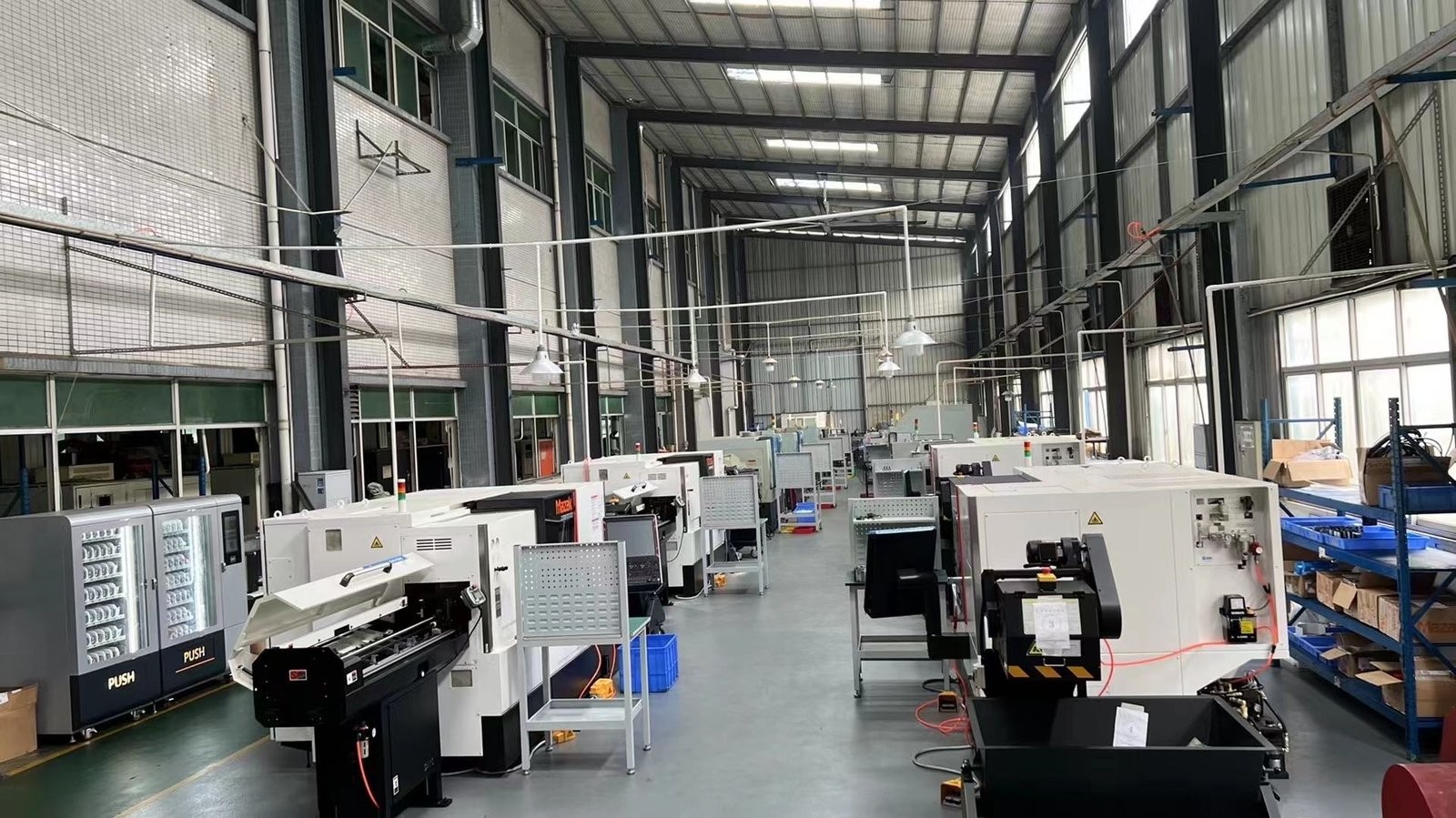
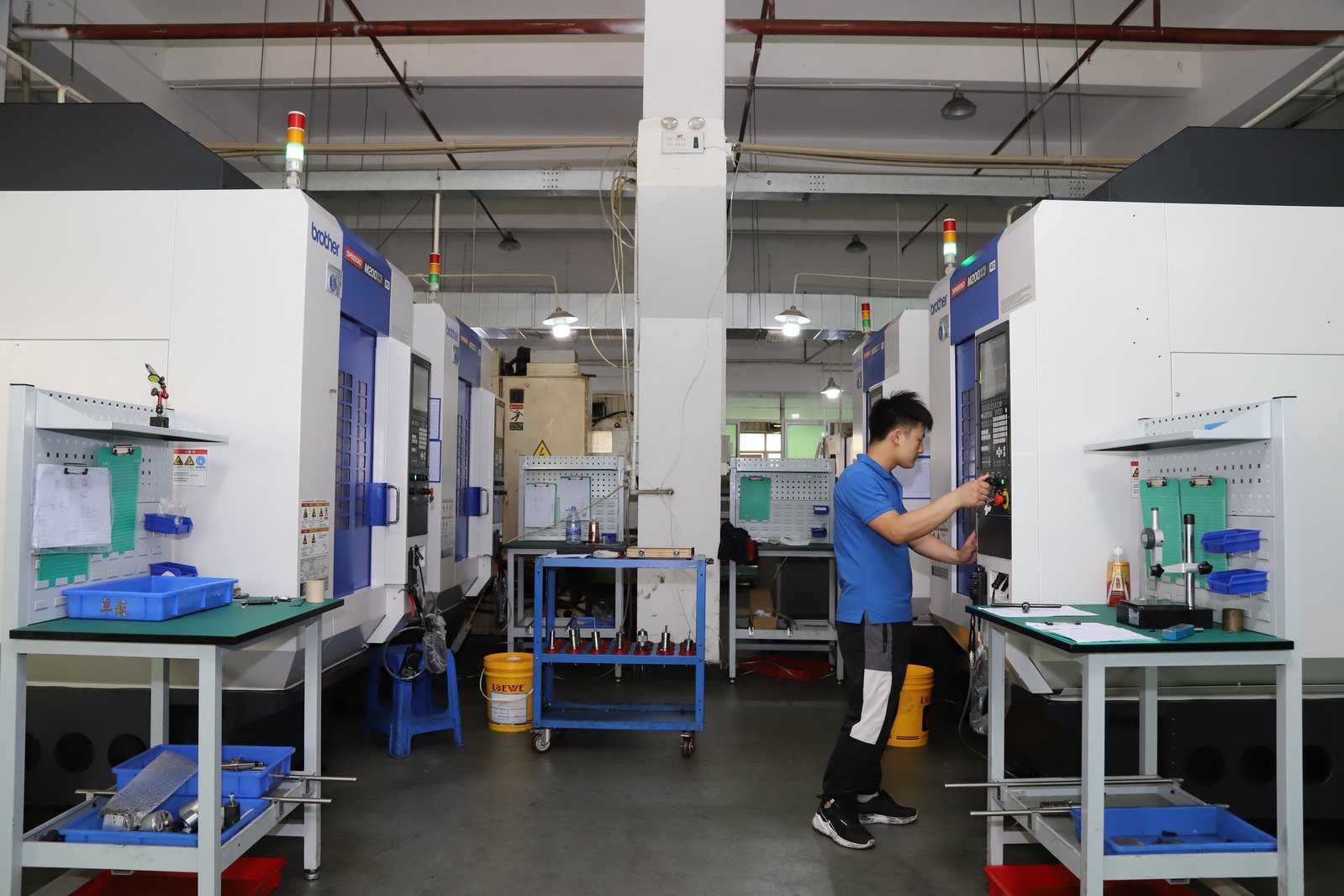
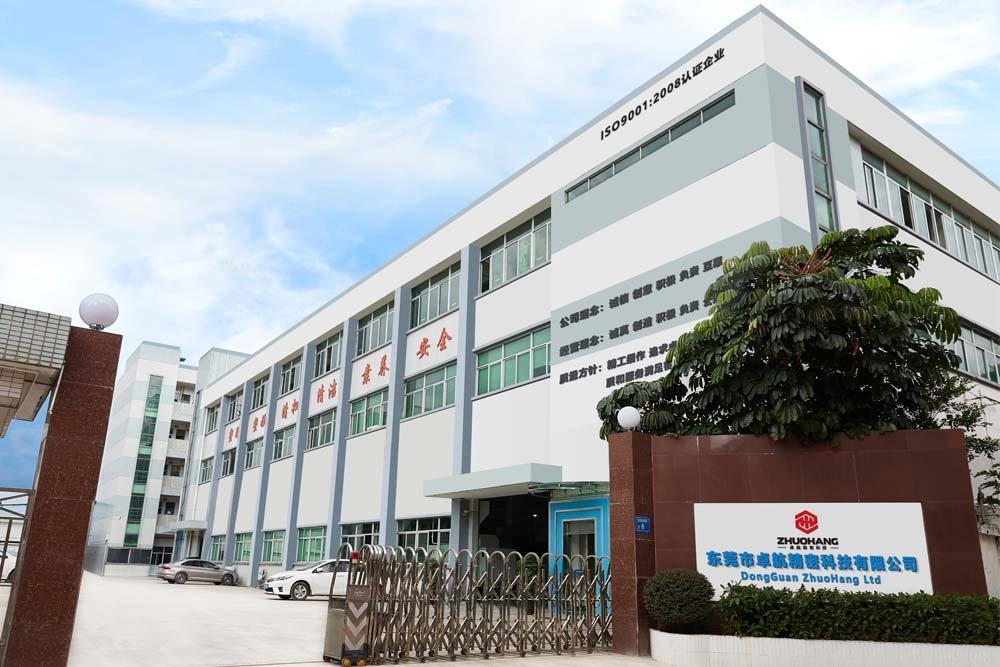
If you ask for capability evidence, you deserve a specific answer. This facility operates 100+ CNC machines across 6,800 m2 in Dongguan, China, staffed by 100+ people. The machines, listed by category:
- 5-axis machining centres (10+) - Mazak VARIAXIS I-600 (510/910/510 mm travel, 12,000 rpm, 22 kW, 71.6 N·m, 30-tool BT40) and Mazak INTEGREX I-250H S (B-axis 0.0001°, 24 kW, 124 N·m, 38-tool HSK-A63). Run on compound-angle parts, single-setup multi-face prismatic work, and aerospace fittings where datum transfer loss is unacceptable.
- 3-axis / 4-axis machining centres (50+) - Brother SPEEDIO S500Z2N / S700Z2N (10,000 rpm, 14/21-tool ATC, 0.7 s tool-to-tool, Z-axis 2.2 G) and Mazak VCE-430A L / VCE-570C L (10,000 rpm, 118 N·m, 24-tool ATC). Run on prismatic parts, plates, brackets, housings.
- Swiss-type turning centres (10+) - Citizen Cincom A20-3F7 (Φ20 mm, 10,000 rpm), TSUGAMI B0206-III / B0205-III (Φ20 mm, 0.1 µm), STAR SR-32JII / SR-32J Type N (Φ32 mm, 8,000 rpm). Run on long, slender rotational parts at ±0.002 mm.
- CNC turning centres (20+) - HEADMAN T70M/1250 (720 mm swing, 117 mm bore, 3,000 rpm, BMT75 12-station turret). Run on shafts, bushings, flanges up to ±0.002 mm.
- Wire EDM (5+) - Sodick AQ535L (550/350/300 mm travel, ±20° taper, 800 kg workpiece). Run on hardened tool steel, internal splines, sharp internal corners that milling cannot reach.
- Inspection: Hexagon CMM + 20+ gauges - Hexagon CMM for coordinate measurement, plus vision system, profilometer, hardness tester, coating thickness gauge, XRF for material verification. The 10:1 rule (gauge 10x more accurate than the band) is applied to every feature.
- Machine highlights - VARIAXIS I-600: one-setup multi-face 5-axis + MAZA-CHECK auto-calibration; INTEGREX I-250H S: DONE-IN-ONE mill-turn, B-axis 0.0001° + Ai thermal shield; SPEEDIO S500Z2N / S700Z2N: Z-axis 2.2 G + 0.7 s ATC; Swiss-type: guide-bush switchable + 0.1 µm resolution.
Tolerance bands: ±0.003 mm milled, ±0.002 mm turned, ±0.002 mm ground or wire-cut. Capability indices: Ppk >= 1.67 at the initial study; Cpk >= 1.33 ongoing in production.
Certifications: ISO 9001:2015 (116024/A/0001/UK/En) · IATF 16949:2016 (131941/A/0001/SM/En, design clause 8.3 excluded) · ISO 14001:2015 (116024/B/0001/UK/En), held by Dongguan Zhuohang Ltd (USCC 91441900MA4UWT6X39, since 2005).
Service area: we supply Austria, Belgium, the Czech Republic, Denmark, France, Germany, Greece, Hungary, Ireland, Italy, the Netherlands, Spain, Sweden and the United Kingdom in Europe; Brazil, Canada, Mexico and the United States in the Americas; China, Israel, Japan, Singapore and Sri Lanka in Asia; Australia and New Zealand in Oceania; and South Africa in Africa, with worldwide delivery from China.
Contact: Felipe Iglesias, [email protected], +86 13126536955.
Confirm the capacity behind your delivery date.
Send your drawing to [email protected] or call +86 13126536955 for a quote built from process steps and loading.
Frequently Asked Questions
How do I know a manufacturer has enough capacity for my volume?
In short, Ask for the machine count and the process spread. 100+ production machines across milling, turning, and grinding means a single failure does not idle your job, and 20+ inspection instruments mean verification never becomes the bottleneck in your schedule.
How does capacity translate into a delivery date?
A delivery date is built from the part's process-step count and the factory's current loading. More steps means more scheduled time; a factory with deep capacity can absorb a breakdown, while a thin one passes the delay to your date.
What tolerances does this manufacturer hold?
In short, ±0.003 mm on CNC milling, ±0.002 mm on CNC turning, and ±0.002 mm for precision grinding, verified on Hexagon CMMs with process capability Ppk ≥ 1.67 at the initial study on key characteristics and Cpk ≥ 1.33 on general characteristics. Capability is reported per characteristic: every report names the feature, its tolerance band, the sample size, the sigma method, and the study window.
Which materials does this manufacturer run?
Aluminum, stainless steel, carbon and alloy steel, brass, copper, titanium, and magnesium, plus engineering plastics. Incoming lots are XRF-checked against the mill certificate, so material verification never delays or derails the schedule.
What is the minimum order quantity?
The MOQ is 1 piece. A first article can be ordered and cleared before volume is committed, which keeps qualification off the critical path and lets the production order run against a proven, predictable schedule.
What certifications back this manufacturer?
ISO 9001:2015 (116024/A/0001/UK/En), IATF 16949:2016 (131941/A/0001/SM/En), and ISO 14001:2015 (116024/B/0001/UK/En). IATF 16949 excludes product design under Clause 8.3 — this is a build-to-print operation.
How do I know which delivery tier my part will land in?
In short, Count the features and the process steps they become. Few operations and no finishing put a part in the ~3-day tier; multiple operations in ~7 days; and ten to twenty steps, or surface finishing or heat treatment, in ~30 days.
Continue reading: CNC Turned Components Factory · CNC Turned Components Services · CNC Turned Components
Standards referenced on this page
- ASTM B211/B211M-19 — Standard Specification for Aluminum-Alloy Rolled or Cold Finished Bar, Rod, and Wire
- ASTM A276/A276M-17 — Standard Specification for Stainless Steel Bars and Shapes
- ISO 9001 — Quality management systems — Requirements