
- Sourcing CNC turning? The short test is not the tolerance on a brochure — it is whether the shop can prove roundness, runout and concentricity with a CMM report for the exact feature you are buying.
- What CNC turning does: the workpiece rotates while a single-point tool cuts it. That is why shafts, pins, bushings and fittings come off a lathe true to axis, and why those three numbers decide whether a turned part fits.
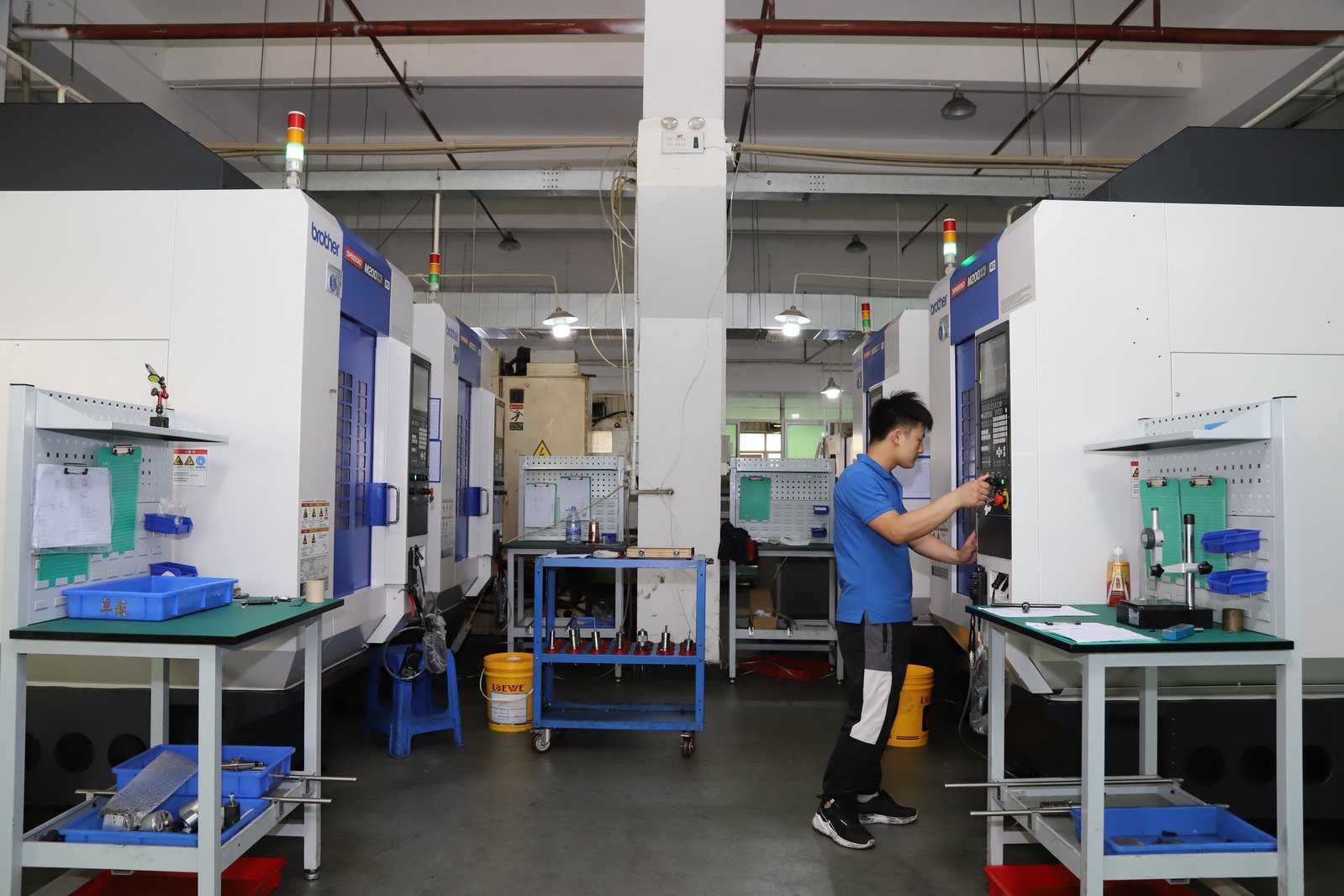
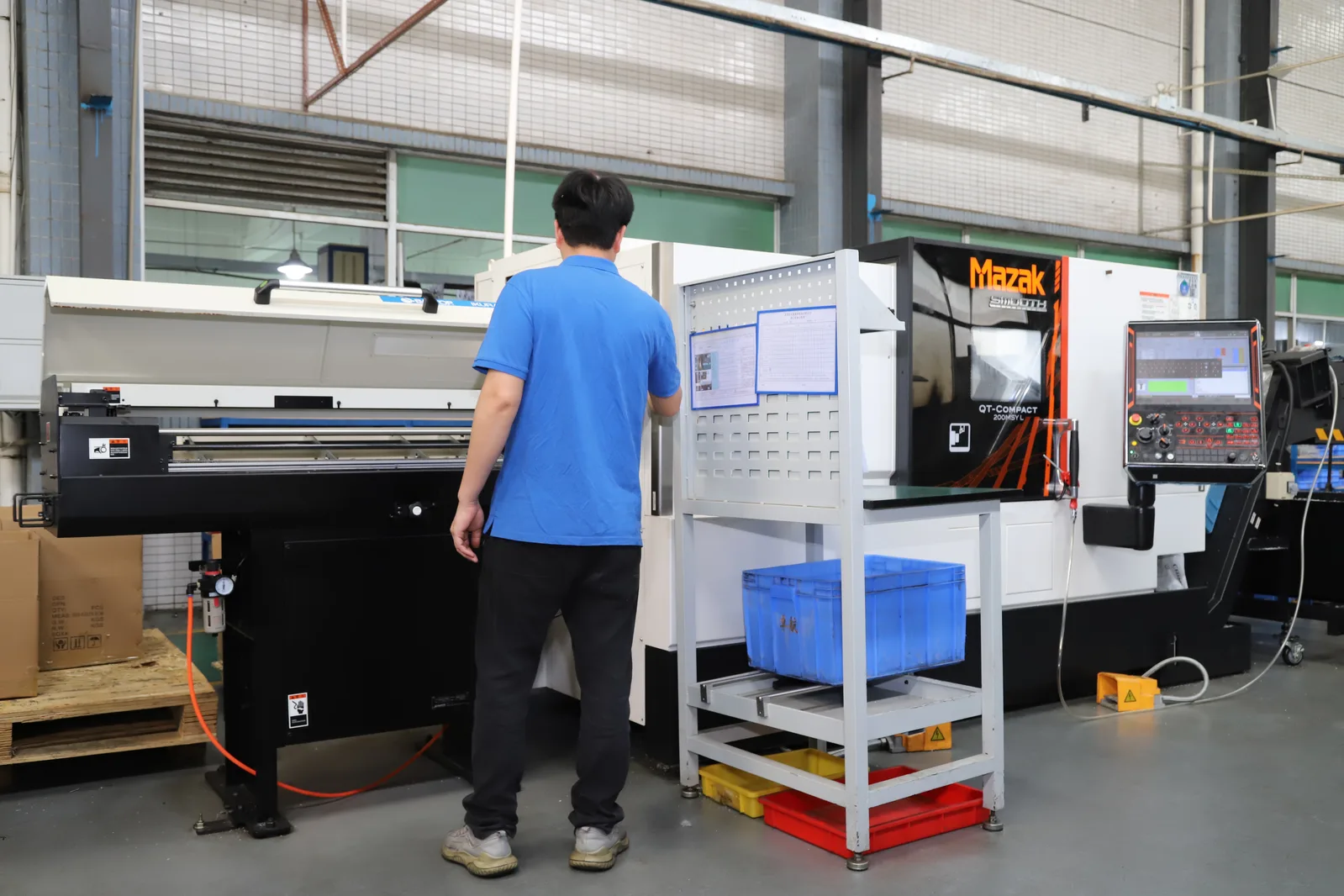
- 100+ production machines — Mazak / Brother / Tsugami / Star / Citizen class, across a 6,800 m² facility (3-axis 50+, 4-axis 20+, 5-axis 20+, 25+ lathes, 7+ grinders, 20+ inspection instruments).
- Tolerance: ±0.003 mm on milling, ±0.002 mm on turning, ±0.002 mm on grinding — verified on Hexagon CMMs. Capability is reported per characteristic: Ppk ≥ 1.67 in the initial study and Cpk ≥ 1.33 in production on key and special characteristics (≥ 1.33 on general characteristics). Every report names the feature, its tolerance band, the sample size, the sigma method, and the study window.
- Certified under ISO 9001:2015, IATF 16949:2016 (design excluded) and ISO 14001:2015 — Dongguan Zhuohang Ltd is the invoicing entity behind them.
- Order terms: minimum order one piece, with 3-, 7- or 30-day lead times depending on how involved the part is.
What are CNC turned components?
CNC turned components are rotational parts — shafts, pins, bushings, spacers, studs — cut on CNC lathes from bar stock, with the workpiece spinning and the tool fed into it. Diameter and length are the critical dimensions, held to ±0.002 mm and verified on CMMs on this Dongguan floor. Because the geometry is long and slender, lead time and handling deserve as much attention as the cut itself.
CNC machining is the subtractive manufacturing of parts on computer-numerically-controlled milling, turning, and grinding equipment. A cutter removes material from a workpiece along a programmed toolpath to produce a part that meets a drawing-defined geometry, tolerance, and surface finish. "CNC" means the tool path is numerically controlled rather than hand-operated.
The rest of this guide turns that definition into a buyer's checklist for this shop — what to verify before you commit, and how the numbers on the drawing actually reach the part.
The discipline separates into milling (the cutter rotates and the workpiece is fed; prismatic geometry), turning (the workpiece rotates and the tool is fed; rotational geometry), and precision grinding / wire EDM (the tightest tolerances on critical features). A plant that produces CNC machined parts end-to-end runs all three.
The output of CNC machining is a part that meets the drawing — geometry, tolerance, surface finish, and material certificate — and is documented to a quality plan (FAI for general work, PPAP for automotive-bound parts, IMDS for material data). That is the answer to "what is CNC machining": a numerically-controlled subtractive process that produces a part to a drawing, with the quality documentation that lets the part enter an assembly.
- 3 / 7 / 30-day tiers — lead time is set by complexity and process-step count, not a blanket promise.
- 100+ production machines — capacity that absorbs a breakdown instead of transmitting it to your date.
- Process steps drive schedule — a complex part can run 10–20 steps; surface finishing lands in the long tier.
- MOQ 1 piece — qualify a first article without blocking your production plan.
How long does a lathe-turned component take to deliver?
The honest answer is "it depends on the part," and the dependency is knowable. Lead time here falls into three tiers — roughly 3, 7, or 30 days, and the tier is set by complexity and the number of process steps, not by a sales promise. A simple, single-material part with few operations ships in about 3 days. A standard multi-operation part lands around 7 days. A complex part with 10–20 process steps, or one that needs surface finishing, sits in the 30-day tier.
The three-tier answer is itself a planning tool. A single quoted date hides the trade-off; a tier exposes it, because it tells you up front whether your part is a fast one or a slow one and lets you steer it — by trimming a step, changing a finish, or resequencing — before the calendar commits. Stating the tier is how a supplier hands the schedule decision back to you, which is the opposite of hiding behind a vague promise.
The value of stating the tiers plainly is that you can plan against them. A supplier that quotes a single date for every part is either guessing or lying; a supplier that maps your part to a tier is giving you a schedule you can hold them to.
You can self-sort your own part before you ask. Count the material changes (one alloy or several), the process changes (turning only, or turning plus milling plus grinding), and the finishing steps (none, or anodizing and heat treatment). Zero finishing steps and few operations puts you at the short end; any finishing or heat treatment puts you at the long end. That rough triage is what the factory formalizes into a tier.
What drives lead time once the bar stock hits the lathe?
The dominant driver is the number of process steps, not the part's size or even its tolerance. Every operation adds scheduled time: a turned part that also needs a milled feature, then a heat treatment, then a plating, carries the sum of all those steps on the calendar. The same metal removed in one operation versus ten is the difference between a 3-day part and a 30-day part.
This is why two parts that look similar can quote very different lead times. The schedule is an arithmetic of steps, and the buyer who understands that can often shorten the date by simplifying the routing, or at least can see, on the quote, exactly which steps are costing the time.
Every process step carries three time components of its own: a setup (programming, tooling, clamping), a run (cutting), and an inspection (measuring and clearing). A part with ten steps is not ten times one step — it is ten setups, ten runs, and ten inspections, plus the queue between each. The queue is the part buyers forget: every hand-off between operations, especially to an outside finishing line, inserts waiting time that no single supplier fully controls. Reading a routing as "steps plus queues" is how you see the real schedule.
How do the three lead-time tiers break down?

| Complexity | Approx. lead time | Typical profile |
|---|---|---|
| Simple | ~3 days | Few operations, single material, no finishing |
| Standard | ~7 days | Multiple operations, standard tolerances |
| Complex | ~30 days | 10–20 process steps, or surface finishing / heat treatment |
The tiers are not arbitrary — they reflect how long the actual sequence of operations takes to run, inspect, and clear. A part with surface finishing falls into the long tier because the finishing step itself has its own queue and inspection, on top of the machining steps before it.
The boundary between tiers is a judgment about step count and finishing, not a rigid wall. A part with eight steps and no finish sits near the top of the standard tier; the same part with an anodize call-out crosses into the complex tier. That is why the tier is assigned from the routing, and why the quote should show you the routing it was assigned from, so you can argue a part back down a tier by removing a non-functional step.
Can you plan around a specific delivery date?
Yes, provided the date is part of the conversation before quoting, not after. A realistic delivery date is built from the part's process-step count and the factory's current loading, so the quote states the logic and the assumptions, and you can see whether your target holds. If your date does not hold, the honest answer is "here is why and here is what would shorten it," not a silent promise that slips later.
Planning around a date also means sequencing correctly: a first article for a new part carries setup time that a reorder does not. If your schedule is tight, order the first article early and let the reorder ride the short, proven-run lead time.
The planning tool underneath this is backward scheduling: start from your needed arrival date, subtract transit, subtract finishing and inspection, subtract machining, and the remainder is the date the drawing and material must be ready. If the drawing or the raw stock is late by two days, no amount of shop-floor speed recovers them — they were already on the critical path. Buyers who plan backward find the real constraints before they find the excuses.
Does the factory have enough capacity for volume?
Capacity is what turns a promised date into a kept one. The 6,800 m² facility runs 100+ production machines — 50+ 3-axis mills, 20+ 4-axis, 20+ 5-axis, 25+ lathes, and 7+ grinders — staffed by 100+ people. That count matters less for raw output than for redundancy: a machine failure or a quality hold on one lot does not idle the rest of your job, because there is another spindle and another inspection instrument to absorb it.
When a supplier has thin capacity, your delivery date competes with every other customer's for the same few machines. When capacity is deep, your date is protected by the machines that are not busy. That is the practical difference capacity planning makes to your schedule.
Capacity depth is measured on two axes, and both matter. The first is spindle count — 50+ 3-axis mills, 20+ 4-axis, 20+ 5-axis, 25+ lathes, and 7+ grinders mean a breakdown is absorbed by a parallel machine, not passed to your date. The second is inspection capacity — 20+ instruments mean a CMM going down, or a lot under investigation, does not stop the other lots from shipping. A shop deep on spindles but thin on inspection will still stall at the quality gate; the two must be read together.
Why do reorders ship faster than first orders?
The first order of a new part carries two phases: setup and first article (programming, tooling, first-article inspection) and then production run. The setup phase dominates the first order's schedule. A reorder of a proven part carries only the run phase, because the setup is already proven, documented, and ready to repeat. That is why reorders of an existing part ship on a much shorter clock than the first order did.
For capacity planning, this is a lever you control: front-load the first article early in your program, and every subsequent release rides the short reorder lead time. The setup you pay once is the schedule you buy for the life of the part.
The setup is not a fee you pay to the factory; it is a capital asset you are buying in the form of proven tooling, a proven program, and a documented inspection plan. Once it exists, it belongs to the part number, not to a single order. If you treat setup as a one-time investment, and reorder as a free rider on that investment, you have understood the economics that make a reorder fast.
How does the drawing affect your delivery date?
A drawing is a schedule input, not just a geometry input. A complete 3D model plus a toleranced 2D drawing removes the clarification loops — "what is this finish, what is this tolerance, is this feature even needed" — that otherwise show up as added setup time and a slipped date. Ambiguity is a hidden tax on lead time, and a clean drawing is the cheapest way to avoid paying it.
There is a second layer: the drawing either is, or is not, manufacturable at the pace you want. A few design-for-manufacturing checks on the print translate directly into schedule. Internal corner radii that are too small force slower toolpaths and extra finishing; a hole depth far beyond its diameter forces a specialty drill and a slower feed; a wall too thin for the process distorts during cutting and needs rework. Each of these is a schedule cost written into the geometry before the part is ever quoted:
- Corner radii. A sharp internal corner cannot be milled with a round tool; a radius too small for a standard cutter adds a finishing operation.
- Hole depth-to-diameter ratio. A deep hole relative to its diameter needs a specialty drill and slower pecking, which adds cycle time.
- Thin walls. A wall that flexes under cutting force produces chatter and rework, pulling the part toward the long tier.
- Unnecessary tight tolerances. A ±0.002 mm (turning) / ±0.003 mm (milling) call-out where ±0.1 mm would serve adds finishing and measurement that the function does not need.
How does MOQ keep qualification off your critical path?
An MOQ of 1 piece means the qualification step does not wait for a production minimum. You order one first article, measure it, and clear the process — while your production schedule is still open. Then the volume order runs against a proven process with a short, predictable lead time. Qualify first, schedule second, and the first article never becomes the bottleneck in your plan.
The first article is only as useful as its inspection is real. A meaningful first article comes with a dimensional report against the print, measured on a CMM, so you are approving a process that actually repeats, not a single lucky part. When the first article and its report are documented, the volume order inherits a proven setup, a proven program, and a proven inspection plan. That inheritance, not the single part, is what keeps qualification off the critical path of the production schedule.
Complex parts can run 10–20 process steps, and surface finishing pushes a part into the long tier. Tell the factory your target date and it will tell you honestly whether the step count supports it, that transparency is what lets you plan with confidence.
What is capacity planning, and why does it decide your delivery date?

Capacity planning is the discipline of matching a factory's finite resources — spindles, people, and inspection instruments — against the demand of incoming orders, on a calendar. A delivery date is the output of that match, not an input to it. The three terms to keep straight are load (the work your order adds), capacity (the work the floor can do per unit of time), and buffer (the idle margin left for breakdowns and rework). A date holds only when load sits below capacity minus buffer.
The practical test is subtraction, not multiplication. A factory that quotes a date without knowing its own current load is guessing; one that subtracts committed work from available spindles before answering is planning. The 6,800 m² floor and 100+ production machines are the capacity side of that subtraction, and the discipline is what keeps the answer honest week after week.
This is why "capacity planning" is not a back-office detail. It is the difference between a schedule you can sequence your own assembly line against, and a schedule you have to babysit. Buyers who read capacity the way a production planner does — machines, load, buffer — are the ones whose dates survive contact with the shop floor.
How does material choice move a turned component between tiers?
Material acts on lead time through two separate channels, and both are knowable before the first chip is cut. The first is availability: how long the raw stock takes to source. The second is machinability: how fast a given alloy cuts, which sets cycle time across the run. A free-machining grade in stock is a 3-day profile; an exotic grade on order is a 30-day profile before anyone programs a toolpath.
| Material family | Typical grades | Machinability | Effect on lead time |
|---|---|---|---|
| Free-machining brass | C360 | Very high — short chips, fast feeds | Keeps a simple part in the ~3-day tier |
| Aluminum | 6061-T6, 7075-T6, 5052 | High — fast cutting, common stock | Short cycle time; exotic tempers add sourcing |
| Carbon / alloy steel | 1018, 1045, 4140 | Moderate — 4140 hardens with heat treat | Fine in annealed state; hardened adds a step |
| Stainless steel | 304, 316 | Moderate — work-hardens, gummy chips | Slower feeds; finishing steps more likely |
| Titanium | Ti-6Al-4V | Low — low thermal conductivity, short tool life | Longer cycle; stress relief may go through a partner |
The buyer-side lever is substitution. If a part is over-specified in an exotic alloy for no functional reason, dropping to a machinable grade can pull it back a full tier. The material question belongs on the quote, not buried in it: a schedule that names the alloy and its sourcing assumption is one you can audit.
How does tolerance change the schedule, not just the spec?
Tolerance is a machining strategy, and every strategy has a cycle-time price. A dimension held at ±0.1 mm runs at full feed with a standard pass. The same feature at ±0.002 mm (turning) / ±0.003 mm (milling) forces slower feeds, a dedicated finishing pass, and more frequent measurement — each of which adds minutes that compound across a run. Grinding to ±0.002 mm adds an entire process step with its own queue and inspection.
| Tolerance band | Typical process | What it does to the schedule |
|---|---|---|
| ISO 2768-m (±0.1 mm at 6–30 mm) | Standard machining | Default pace; no extra passes |
| ±0.02 to ±0.05 mm | Finishing pass, controlled feeds | Adds cycle time and measurement frequency |
| ±0.002 mm (turning) / ±0.003 mm (milling) | Precision milling / turning | Slower feed, dedicated finish op, CMM checks |
| ±0.002 mm | Precision grinding | Adds a grinding step with its own queue |
The second-order effect is the one buyers miss: over-tolerancing a non-functional feature does not just raise cost — it buys schedule risk you did not need. A drawing that calls ±0.002 mm (turning) / ±0.003 mm (milling) where ±0.1 mm would work has quietly moved the part toward the long tier. Reading the tolerance column of a print as a schedule input — not just a quality input — is how you keep a part in the tier it belongs in.
How does surface finish push a part into the long tier?
Surface finish is the step that most reliably moves a part from the short tier to the long one, for a mechanical reason: it is a separate operation with its own queue, its own setup, and its own inspection, stacked on top of every machining step before it. A part that is otherwise simple becomes a 30-day part the moment it needs anodizing, plating, or powder coating.
| Finish / Ra target | How it is produced | Effect on the schedule |
|---|---|---|
| Ra 3.2 µm | Standard machining | No added step; stays in the short tier |
| Ra 1.6 µm | Finishing pass or light grinding | Adds cycle time, possibly a pass |
| Ra 0.8 µm | Precision grinding / honing | Adds a grinding or honing step |
| Anodizing / plating / powder coat | External finishing line | Own queue and inspection — lands in the 30-day tier |
The honest quote names the finishing step and its assumption up front, so the long tier is a decision you can see, not a surprise you discover mid-order. If the finish is decorative rather than functional, dropping or simplifying it is often the single fastest way to shorten the date.
How does a single lathe setup shorten the calendar?
Every re-clamping of a part is a scheduled event: a setup, a locating, and a re-inspection, each of which is a place where a delay can hide. Mill-turn and multi-task machines combine turning and milling in one clamping, which deletes those events from the calendar entirely. Fewer setups means fewer schedule line items and fewer queue points between operations.
The schedule benefit has a quality side too. Features that must be concentric are cut from a single reference on a mill-turn, instead of being re-established across fixtures. That consistency means fewer reworked parts and fewer re-inspections, both of which would otherwise show up as schedule slips. For a turned component with milled flats, cross-holes, or keyways, single-setup machining is the difference between a routing with six hand-offs and one with none.
How does batch size interact with setup time to set the real lead time?
Every job splits into two kinds of time: setup (programming, tooling, first-article approval) and run (cutting each piece). Setup is paid once; run scales with quantity. On a one-piece first article, setup dominates the clock. On a ten-thousand-piece production order, setup amortizes to nothing and run time is the schedule. This arithmetic — not the part's size — is why first orders are slow and reorders are fast.
| Order type | What dominates the clock | Practical effect on the date |
|---|---|---|
| First article (MOQ 1) | Setup + first-article inspection | Longer once, but clears the process for life |
| Low-volume batch | Setup amortized over few parts | Setup still visible in the per-part time |
| Production reorder | Run time only | Short, predictable reorder lead time |
The lever is sequencing: pay the setup once, early, on a first article, and every release after rides the short reorder clock. Buyers who understand the setup/run split can read a quote and see whether a quoted date is consistent with the batch they actually asked for.
What happens when capacity is thin, and what signals should make you walk away?
Thin capacity is not a hidden quantity; it leaks into the quoting behavior. The failure mode is predictable: your date competes with every other customer for the same few spindles, so the quote becomes a guess that drifts the moment an urgent order lands in front of yours. Red flags are consistent and worth reading for:
- A single date with no logic. A quote that names a tier and the step count behind it is a plan; a bare date with no stated assumptions is a wish.
- No machine count or process spread. A shop that will not tell you how many spindles it runs is telling you it does not have enough to matter.
- No inspection redundancy. If one CMM or one inspector is the whole verification capacity, a quality hold becomes a full stop.
- A date that shifts on every re-quote. A stable process produces a stable date; a drifting one signals a floor that is over-committed.
- No answer on how a hold is isolated. If a quality problem stops the whole line instead of one lot, your date inherits everyone else's problems.
If a supplier cannot state the machines, the load, and the buffer behind a date, treat the date as a guess, and plan your own line accordingly.
How do you read a machining quote for hidden schedule risk?
A quote is a schedule document in disguise. Read it the way you would read a routing, and the hidden risks surface before they cost you a week:
- Are the process steps listed? A quote that names turning, milling, grinding, and finishing lets you verify the tier; one that hides the steps hides the time.
- Are outsourced steps flagged? Finishing and heat treatment that run through a partner carry a queue you do not control; the quote should say so.
- Does the date carry stated assumptions? The tier, the step count, and the material sourcing should be written down, so the date is auditable.
- Is the capacity verifiable? Machine count and inspection capacity should be checkable against a floor visit or a live video walk.
- How is a hold isolated? The quote should be able to answer what happens to the rest of the schedule if one lot fails.
A supplier that answers all five is giving you a plan. A supplier that answers none is selling you a number. The difference shows up as a kept date versus a slipped one.
How does a first article de-risk the entire program schedule?
A first article is the cheapest schedule insurance available in machining. With an MOQ of 1 piece, you order one part, measure it against the print, and clear the process before volume is committed. A dimensional or DFM problem found on one part costs a correction; the same problem found on a ten-thousand-piece run costs a re-run, a re-inspection, and a production line idled waiting for the fix.
The reason it works is that the first article runs under the same SPC and inspection discipline as the production run, so it is a meaningful qualification rather than a courtesy sample. It proves the process before the process is asked to repeat ten thousand times. Qualify first, schedule second, and the volume order runs against a proven clock instead of a hoped-for one.
How do you plan capacity across a mixed-parts order with different tiers?
A multi-line order is a small portfolio, and it has a critical path: the longest-tier part sets the date for the whole shipment, because the order cannot clear until the slowest line item clears. Planning it well is sequencing, not hoping:
- Release the long-tier parts first. The 30-day part should be in the queue the day the order is placed, not the day the short parts are done.
- Front-load first articles. Every new part number carries setup; clear those early so the reorders ride the short clock.
- Group by finish. Parts that share an anodizing or plating lot move together through the finishing queue instead of each waiting separately.
- State the assumption. Ask the quote to show which line item is the critical path, so the schedule is a plan you can hold, not a single blended number.
The buyer who reads a mixed order as a set of tiers — and sequences accordingly — gets the whole shipment on the longest tier's schedule, not a surprise at the end.
How do different industries load the same capacity differently?
The same a hundred-odd machines and the same three tiers serve very different masters, because each industry asks a different question of the schedule. Reading those differences is how you know whether a factory's capacity planning matches the way your own program actually runs.
| Industry | What it stresses | What that means for the schedule |
|---|---|---|
| E-bike / light mobility | Fast iteration, frequent design changes | Short-tier parts and quick first articles matter more than deep volume |
| Medical devices | Traceability, validation, clean documentation | Qualification and lot-level records sit on the critical path, not just machining |
| Robotics / automation | Tight fits across many mating parts | Tolerances and single-setup consistency protect the assembly date |
| Semiconductor equipment | Precision, clean surfaces, exotic materials | Grinding and finishing steps push parts into the long tier by design |
The takeaway is not that one industry is harder. It is that "on time" means a different thing in each, and the schedule has to be built for the one you are in. If you state the industry's real constraint — iteration speed, traceability, or assembly fit — you give the planner the information needed to sequence the work correctly, instead of defaulting to a generic date.
When does the delivery clock actually stop? Transit, Incoterms, and the definition of "delivered"
"Lead time" has an unspoken boundary, and two buyers can read the same quote differently because of it. The machining lead time ends when the parts clear inspection; the delivery clock, the one that matters to your line, ends when the parts arrive and clear your receiving. Between those two points sits transit, customs, and the Incoterm that defines who owns the risk in between.
The common Incoterms mark the hand-off on a spectrum. EXW (Ex Works) transfers the risk at the factory gate, so you own transit and customs from the start. FOB (Free on Board) transfers it when goods are on the vessel at the port of loading. CIF (Cost, Insurance, Freight) has the seller pay freight and insurance to the destination port, but risk still passes at loading. DAP (Delivered at Place) and DDP (Delivered Duty Paid) push delivery toward your door, with DDP placing import duties on the seller.
The planning point is simple: ask which Incoterm the quoted date assumes, because the same machining week can arrive as very different calendar dates under EXW versus DAP. A schedule that names its Incoterm is a schedule you can put on your own calendar without a hidden gap in the middle.
How much buffer should a schedule carry, and what does buffer hide?
Buffer is the idle margin between load and capacity, and it is the part of a schedule that is easiest to fake. Too little buffer means every hiccup lands on your date. Too much buffer, padded in secret, means you are paying for slack you cannot see, and a supplier that hides the buffer is one you cannot plan against. The honest schedule states the machining time, the transit, and the buffer separately.
The red-flag reading is asymmetry. A date with a stated tier, a stated step count, and a stated transit assumption is auditable; you can ask where the buffer sits and whether a tighter date is possible by trimming a step. A date that is just a number, with no breakdown, is a buffer you cannot inspect, which makes it indistinguishable from a guess. Buyers who demand the breakdown get a plan; buyers who accept the number get a surprise.
What does "on-time" actually measure, and how do you verify it?
On-time delivery (OTD) is a claim until it is defined, and the definition has three parts that must all be stated: the event (parts clear final inspection, or parts arrive at your dock), the window (the calendar date, or a date with a tolerance band), and the unit (per line item, or per shipment). A factory that says "99% on time" without defining those three is reporting a number that cannot be checked.
Verification runs backward from your own receiving record, not forward from the supplier's promise. You can check OTD by comparing the confirmed date on each order to the date the parts actually cleared your dock, line item by line item, over enough orders that one good month does not flatter the average. A supplier whose real OTD holds up under that kind of look-back is one whose capacity planning is real, because OTD is simply capacity planning measured from the other end.
How does a machining cluster's supply base shorten your lead time?
Location is a supply-chain variable, not a trivia item. A factory inside a dense precision-machining region — like the one this site describes, at No. 8, Shuibian Songyuan Road, Hengli Town, Dongguan — sits next to the raw-material stockists and the secondary-process shops that a schedule depends on. Bar stock is re-sourced in days rather than weeks, and a surface treatment can be queued with a partner down the road instead of shipped across a country.
The schedule effect is concrete. Two factories can quote the same machining hours, but the one with a short supply base turns those hours into a short calendar, while the isolated one pads every step with transit and lead time it does not control. When you compare suppliers, ask where their material comes from and where their finishing runs — the answer is part of the lead time even though it never appears on the routing.
The reverse risk is equally worth asking about. A factory that relies on a thin local supply base for a specialty alloy or a rare finish will pass that scarcity straight to your date. The question "where does this step actually happen" is a capacity-planning question in disguise, because every outside step is a queue you are indirectly paying for.
What is the difference between lead time, cycle time, and takt time?
Three clocks run through every machining program, and conflating them is how schedules get misread. Lead time is the calendar span from order to delivery — the number you plan your line around. Cycle time is the machining seconds it takes to make one part — a shop-floor number that sets how fast a run moves. Takt time is the pace your assembly line needs parts at — a demand-side number that sets how many parts per hour must arrive.
The three connect through capacity. If your takt time needs a part every 60 seconds and the cycle time to machine one is 50 seconds, one spindle covers the need in theory; but lead time still includes setup, queue, inspection, and transit, so the calendar gap between the two is where the real planning lives. Buyers who confuse cycle time for lead time will under-plan by weeks; buyers who know the difference ask the right question — "what is the lead time, and what does it assume about cycle and queue" — and get an answer they can use.
How do you compress lead time without compromising the part?
Lead time is not a fixed property of a part; it is a property of the routing, and the routing is negotiable. The legitimate levers all shorten the calendar without cutting corners on quality, and each is a question you can put to the supplier:
- Merge steps. A mill-turn or multi-task machine cuts turning and milling in one setup, deleting hand-offs and their queues.
- Substitute material. A machinable grade that meets the function cuts cycle time and often sourcing time.
- Relax non-functional tolerances. A ±0.1 mm call-out where ±0.002 mm (turning) / ±0.003 mm (milling) was over-specified removes a finishing pass and its measurement.
- Drop or simplify a finish. A decorative anodize that is not needed is the single fastest way back from the 30-day tier.
- Front-load the first article. Clear the process early so the production reorder rides the short, proven-run clock.
- Sequence in parallel. Release long-tier parts and first articles the day the order is placed, so they never wait behind short parts.
What none of these levers do is promise a date the process cannot hold. A supplier that offers to compress the date by trimming real steps, and shows you which steps, is planning. One that simply shaves days off the number without touching the routing is guessing, and the difference shows up at your dock.
How do you hold a supplier accountable to the date it quoted?
A delivery date is only as enforceable as the logic written under it. The moment a supplier writes down the tier, the step count, and the assumptions, the date stops being an opinion and becomes a commitment with a paper trail. Holding it accountable is then a matter of checking the milestones, not waiting for the final day to discover the slip.
Three practices do the work. First, get the date and its logic in the written order confirmation, so a change to either is a visible event, not a silent drift. Second, ask for a mid-run checkpoint — a first-article report, or a machining-complete notice — so a delay is caught while there is still time to react. Third, agree in advance what a slip triggers, whether that is expedited transit, a revised commit, or a re-plan of your own downstream line.
None of this is adversarial; it is the same discipline the factory applies to its own schedule. A supplier that welcomes the checkpoints is one whose date was real in the first place. A supplier that resists them is telling you, in the only language that matters, that the date was a hope, and that is the signal to plan accordingly.
Guides
- CNC turned components cost in 2026 — your cost model built from process steps.
What this shop actually runs
A buyer asking for capability evidence should get a specific answer. The facility behind this guide operates 100+ CNC machines across a 6,800 m2 plant in Dongguan, China, with 100+ staff. The machine list by category:
- 5-axis machining centres (10+) - Mazak VARIAXIS I-600 (510/910/510 mm travel, 12,000 rpm, 22 kW, 71.6 N·m, 30-tool BT40) and Mazak INTEGREX I-250H S (B-axis 0.0001°, 24 kW, 124 N·m, 38-tool HSK-A63). Run on compound-angle parts, single-setup multi-face prismatic work, and aerospace fittings where datum transfer loss is unacceptable.
- 3-axis / 4-axis machining centres (50+) - Brother SPEEDIO S500Z2N / S700Z2N (10,000 rpm, 14/21-tool ATC, 0.7 s tool-to-tool, Z-axis 2.2 G) and Mazak VCE-430A L / VCE-570C L (10,000 rpm, 118 N·m, 24-tool ATC). Run on prismatic parts, plates, brackets, housings.
- Swiss-type turning centres (10+) - Citizen Cincom A20-3F7 (Φ20 mm, 10,000 rpm), TSUGAMI B0206-III / B0205-III (Φ20 mm, 0.1 µm), STAR SR-32JII / SR-32J Type N (Φ32 mm, 8,000 rpm). Run on long, slender rotational parts at ±0.002 mm.
- CNC turning centres (20+) - HEADMAN T70M/1250 (720 mm swing, 117 mm bore, 3,000 rpm, BMT75 12-station turret). Run on shafts, bushings, flanges up to ±0.002 mm.
- Wire EDM (5+) - Sodick AQ535L (550/350/300 mm travel, ±20° taper, 800 kg workpiece). Run on hardened tool steel, internal splines, sharp internal corners that milling cannot reach.
- Inspection: Hexagon CMM + 20+ gauges - Hexagon CMM for coordinate measurement, plus vision system, profilometer, hardness tester, coating thickness gauge, XRF for material verification. The 10:1 rule (gauge 10x more accurate than the band) is applied to every feature.
- Machine highlights - VARIAXIS I-600: one-setup multi-face 5-axis + MAZA-CHECK auto-calibration; INTEGREX I-250H S: DONE-IN-ONE mill-turn, B-axis 0.0001° + Ai thermal shield; SPEEDIO S500Z2N / S700Z2N: Z-axis 2.2 G + 0.7 s ATC; Swiss-type: guide-bush switchable + 0.1 µm resolution.
Tolerance bands held: ±0.003 mm on CNC milling, ±0.002 mm on CNC turning, ±0.002 mm on precision grinding and wire EDM. Capability indices: Ppk >= 1.67 initial on key characteristics; Cpk >= 1.33 ongoing in production.
Certifications: ISO 9001:2015 (116024/A/0001/UK/En), IATF 16949:2016 (131941/A/0001/SM/En, design clause 8.3 excluded - disclosed openly), ISO 14001:2015 (116024/B/0001/UK/En). Certificates are issued to Dongguan Zhuohang Ltd (USCC 91441900MA4UWT6X39, established 2005).
Service area: Austria, Belgium, the Czech Republic, Denmark, France, Germany, Greece, Hungary, Ireland, Italy, the Netherlands, Spain, Sweden and the United Kingdom in Europe; Brazil, Canada, Mexico and the United States in the Americas; China, Israel, Japan, Singapore and Sri Lanka in Asia; Australia and New Zealand in Oceania; and South Africa in Africa. Based in China, serving customers worldwide.
Contact: Felipe Iglesias, [email protected], +86 13126536955.
Plan your delivery date with the process-step logic.
Send your drawing to [email protected] or call +86 13126536955 for a tiered lead-time quote with assumptions stated.
Frequently Asked Questions
How long do CNC turned components take to deliver?
Roughly 3, 7, or 30 days depending on part complexity and the number of process steps. A simple single-material part ships in about 3 days; a part with 10–20 process steps, or with surface finishing, falls into the 30-day tier.
What drives lead time on a turned component?
The number of process steps is the dominant driver, not the part's size. Each extra operation — a second milling pass, a heat treatment, a plating — adds scheduled time. Surface finishing in particular pushes a part into the longer tier.
Can you plan around my delivery date?
Yes, provided the schedule is discussed before quoting. A realistic delivery date is built from the part's process steps and the factory's current loading, so the quote states the logic rather than promising a date it cannot hold.
Is the factory capacity enough for your volume?
The 6,800 m² facility runs 100+ production machines — 50+ 3-axis, 20+ 4-axis, 20+ 5-axis mills, 25+ lathes, and 7+ grinders — with 100+ people. That redundancy means a single machine failure does not idle your job.
Why exactly do reorders ship faster than first orders?
The first order carries setup and first-article approval time — programming, tooling, and inspection. A reorder of a proven part carries only run time, because the setup is already proven and documented. The schedule shortens.
What is the MOQ for turned components?
The MOQ is 1 piece, so a first article can be ordered and validated before volume is committed. This keeps the qualification phase off the critical path of your production schedule.
How does material choice affect lead time?
In short, Through two channels: availability (how fast the stock is sourced) and machinability (how fast the alloy cuts). A free-machining grade in stock keeps a part in the ~3-day tier; an exotic alloy on order, or a hard-to-cut grade like titanium, pushes it toward the long tier.
How does tolerance affect lead time?
Tight tolerance forces slower feeds, a finishing pass, and more measurement, and grinding to ±0.002 mm adds a whole process step. Over-tolerancing a non-functional feature quietly moves a part toward the long tier without buying any function.
What should I check in a machining quote before trusting the date?
In short, Confirm the process steps are listed, outsourced steps are flagged, the date carries stated assumptions, the capacity is verifiable, and a quality hold can be isolated to one lot. A quote that answers all five is a plan; one that answers none is a guess.
How do I plan a mixed order with parts in different tiers?
Release the longest-tier part first, front-load first articles, group parts by shared finish, and ask the quote to name the critical path. The slowest line item sets the shipment date, so it should enter the queue first.
How does the factory's location affect lead time?
In short, A factory inside a machining cluster re-sources raw stock and queues surface finishing faster than an isolated one. Every outside step — material or finishing — is a queue you indirectly pay for, so the supplier's supply base is part of the lead time even though it never appears on the routing.
Do you use MIL-STD-105E or ANSI/ASQ Z1.4 sampling inspection?
In short, MIL-STD-105E is the U.S. military sampling inspection standard published in 1989; it specifies acceptable quality limit (AQL) sampling plans for lot-by-lot inspection.
Standards referenced on this page
- ASTM B211/B211M-19 — Standard Specification for Aluminum-Alloy Rolled or Cold Finished Bar, Rod, and Wire
- ASTM A582/A582M-12 — Standard Specification for Free-Machining Stainless Steel Bars
- ISO 9001 — Quality management systems — Requirements
Cncturnedcomponents Knowledge Base
Every dimension of cncturnedcomponents a hardware buyer needs to qualify a supplier, verify a claim, or make a sourcing decision — organised by topic.
Factory & Certifications
Top 10 reasons to choose Zhuohang as your best CNC Turned Components supplier
Every buyer shortlisting a CNC Turned Components supplier ends up asking the same ten questions. Here is how Zhuohang answers each one — with the plant, the certificates and the numbers behind the answer, not adjectives.
- No minimum order. A single piece runs on the same program and datum as production, so what you sign off is what you receive at volume.
- Quote plus DFM in ~48 hours. The cost-lowering changes to your CNC Turned Components part are raised before machining begins, so there are no surprises at billing.
- Verifiable, not virtual. A 6,800 m² plant in Hengli, Dongguan, running since 2005 as Dongguan Zhuohang Ltd (USCC 91441900MA4UWT6X39) — audit the floor behind your parts.
- Shipments that clear. Material certification goes with every order, and the US Section 301 / Section 232 and EU CBAM status is kept current for our HS codes.
- Numbers that bind. ±0.003 mm on milled features and ±0.002 mm on turned features, with precision grinding and wire EDM also to ±0.002 mm — verified on the part.
- Certified end to end. The same floor holds ISO 9001:2015, IATF 16949:2016 (design excluded) and ISO 14001:2015, so a CNC Turned Components sample and an automotive run share one standard.
- Seven languages. English, Japanese, Portuguese, Spanish, French, Chinese and Cantonese — your drawing is answered in the language it was sent.
- One roof, one system. CNC Turned Components parts move through milling, turning, mill-turn, grinding and wire EDM without leaving the building or the quality system.
- Machines you can name-check. Mazak VARIAXIS I-600, Mazak INTEGREX I-250H S, and Tsugami, Star and Citizen Swiss lathes — the gear behind tight features.
- Numbers, not opinions. Hexagon CMM and vision checks on every lot, with capability reported as Ppk ≥ 1.67 initially and Cpk ≥ 1.33 in production, each with index, stage and sigma method.
Want to test any of the ten? Send a drawing for a quote within 48 hours — or talk to our team in English, Japanese, Portuguese, Spanish, French, Chinese or Cantonese.